

JJ Tree Surgeons, before and after
John's old website was put together for him by a directory company. There wasn't a single photo of his own work on it, even though his Instagram held 378 photos. This is the site he had, next to the one he has now.

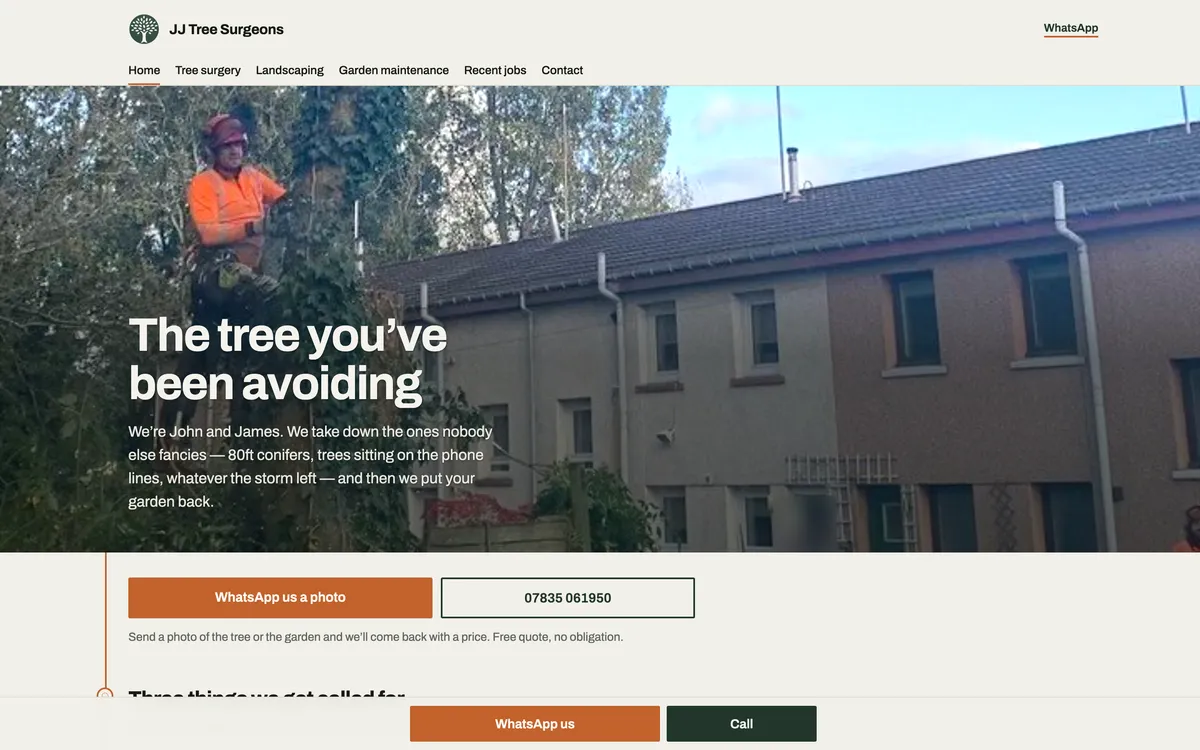
Scroll through both
This is the home page of each site, scrolled from top to bottom side by side: the old one on the left, the new one on the right.
How it started
I sent John an email on the 14th of August. On the 31st he got back to me on WhatsApp, so I gave him a ring.
He already had a website. A directory company had set it up for him, and it never really looked like his business. He wanted to keep the web address, because it's printed on his vans, and he wanted to keep his info@ email address too.
So I asked him what he'd want instead: home, tree surgery, landscaping, garden maintenance and a way to get in touch. And he told me his Instagram was a better record of his work than his Facebook, so that's where I started.
Two days later, on the 2nd of September, I sent him the finished site on WhatsApp. He hadn't paid me anything or signed anything. That evening he replied:
Thats class Grant thank you for taking the time to do that! The lay out, the ideas, the feedback etc! All great!
He signed up on the 8th of September.
That's how I do all of these. You see the real site, for your business, with your own photos on it, before you've paid me a penny. If it isn't right, it comes down, and that's the end of it. No invoice, no awkwardness.
What was on the old site
None of this was John's doing, and none of it is unusual. It's what you tend to get when a website is put together from a template.
- Not one photo of his own work. Every photo on it was a stock picture. Most came from the website builder's own free image library. One of them, a pair of hands trimming grass with shears, is a stock photo you'll find on other landscaping websites too. The only images that came from John were his logo, and the same logo again as the little icon in the browser tab. His Instagram had 378 photos on it at the time.
Apart from his phone number, his email address and his logo, very little on it came from him.
Why it looks the way it does
None of it came from a template. Every choice started from John's own work.
- His own photos do the talking. The first thing you see is one of his team roped in on an ivy-covered tree above a row of Glasgow houses. Every photo on the site is his.
- A rope runs down every page. An orange line runs down the side of each page, with a ring marking every new section, like the climbing rope his team work on. It's a detail that could only belong to a tree surgeon.
- Before and after, side by side. His own Instagram had jobs photographed before and after, so I built the site around them: the same spot, before and after, shown together.
- Made for a phone in the garden. A "WhatsApp us a photo" button sits near the top, and a WhatsApp and Call bar stays at the bottom of the screen. On a phone, the old site's first screen was a stock photo and a cookie notice.
- It sounds like him. It opens with "We're John and James", in plain words taken from his own captions and his customers' reviews. The old site talked about "top-tier" service and a "commitment to excellence".
The old site could have belonged to any tree surgeon. This one could only be John's.
Where the words and the pictures came from
Every photo on the new site comes from John's own Instagram. Before I wrote anything, I read all 88 of his reviews on MyBuilder and every caption he'd written on his posts.
Then I wrote the site out of that. Before I sent it to him, I went back through it line by line and logged where every sentence had come from. Counting the writing, not the menus, the labels or the contact details, the first version, the one I sent him on the 2nd of September, broke down like this:
- Eleven per cent is word for word: sentences lifted straight out of his customers' reviews and his own captions.
- Seventy-one per cent is his own words, reworded to sit properly on a page.
- Eighteen per cent is mine: the headings, the links, and the sentences that join one thing to the next.
Every line is logged against the post or the review it came from, or as mine. Where a line goes further than its source, the record says so in writing.
That's the whole difference. You can usually tell, reading a small business's website, whether it was written about them or written out of what they actually do.
Moving it over
The slow part wasn't the website. His web address was held by the directory company, and so was his info@ email. The old site and that email were both due to be switched off on the 4th of October.
There's no button for leaving. Moving his web address meant a support request in John's name, a form that had to come from an email address they already had on file, and a lot of phone calls to chase it along. That's a lot to ask of someone who's up a tree all day.
John rang them twice himself: once to start the move, and once to add me to his account so I could deal with them directly. From there I took it on. I made the calls, filled in their form so all he had to do was send it on, and kept chasing until it moved. Even on the last day, it took one more phone call to get it actually done.
His web address came across on the 29th of September, and the new site went live on it the same afternoon, five days before the deadline. The address on his vans didn't have to change, and it's registered in his own name. His info@ address now goes straight to the email he already checks on his phone, and so does anything sent through the contact form.
That's the part I'd point to. With me there's no call centre, and no being passed between a website department, an email department and a billing department. It's one person, and it's me.
On a phone
A lot of people looking for a tree surgeon are standing in the garden looking at the tree when they search. This is the comparison that matters.
Page by page
The same side-by-side scroll, for three more pages.
What's on it
- Six pages: home, tree surgery, landscaping, garden maintenance, recent jobs and contact, instead of one page trying to say everything. The recent jobs page was added once the site was live.
- Before-and-afters, job by job, on their own Recent jobs page.
- A photo-first way to get a quote. Stand in the garden, take a picture of the tree, send it on WhatsApp to his own number, and get a price back. No form to fight with on a phone.
- Seven of his customers' reviews, word for word, with the dates on them, plus links to his MyBuilder profile and to leave him a Google review.
- His own job photos throughout, captioned with what the job actually was.
- Hosted on Amazon Web Services. The pages come straight from Amazon's storage, so there's no server in a back room to fall over, and updating the site doesn't take it offline.
Unbelievable service. Websites is something ive always struggled with and Grant could not make this more simple, literally deals with everything leaving my to get on with other aspects in my business. Couldnt recommend enough!
If your website isn't showing off your work, I'll build you a new one first.
Same as John's. I'll make the real thing, with your photos, your words and your jobs, and send you the link. You look at it, and then you decide. No card, no obligation.
Get my free mockupOr call 07459 934592 or message on WhatsApp
I'll reply within 4 working hours, Mon–Fri.